
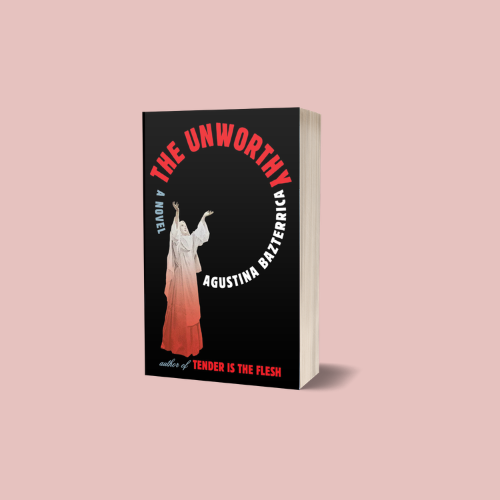
The Unworthy by Agustina Bazterrica is an incredibly relevant work. The novel falls under literary horror—an accurate description given its post-apocalyptic storyline, shaped by societal and environmental collapse. It is structured as a diary written by an unnamed narrator. Through fragmented entries, readers are ushered into the world as it exists in the novel’s present. For the narrator in particular, that world is not only plagued by ecological disaster and social decay, but by the House of the Sacred Sisterhood, an extreme religious convent she has been brought into.
Moving convincingly through the world Bazterrica has built, the narrative honors the conventions of the diary form: scattered pieces said to be written in blood, dirt, or whatever material is available, marked by strikethroughs, omissions, and abrupt stops that emphasize the conditions the narrator is writing under. Bazterrica is equally attentive to language. Grounded in sensory detail, the novel’s ornate style is paired with unvarnished descriptions of internal and external bodily experience, immersing the reader fully and without restraint.
In many ways, Bazterrica succeeds in showing how the world’s pre-existing practices and systems continue to operate, even after catastrophe: unflinching depictions of the brutalization of women, institutional misogyny, and patriarchal control. She is unafraid to examine the cyclical nature of violence and to draw attention to the blurred line between victimhood and perpetration. While her ability to explore these themes so sharply is an achievement in itself, it is her interrogation of humanity that most earns my recommendation.
Disillusionment with ourselves is not difficult to understand. We lose confidence in our humanity—and often, rightly so. We begin to question how, or whether, it is possible to return to it again after everything we’ve witnessed and done. If Tender Is the Flesh, Bazterrica’s earlier work, explores the consequences of our lost humanity and our growing desensitization, The Unworthy feels like a response, and even like a roadmap back. In Tender Is the Flesh, Bazterrica confronts apathy and warns against it; in The Unworthy, she offers an unwavering testament to survival. The narrator’s diary entries chart the endurance of psychological and physical torment, and the slow emergence of hope and shared belonging.
Bazterrica’s work provides a relatable outlet for those of us trying to understand the world we have found ourselves in. For writers of all kinds, that ability has become a necessary tool. Historically, writing has been an act of salvation in the face of persecution. And yet it has become far too easy to lose sight of writing’s purpose, or to judge a novel’s worth solely by its ability to entertain. To measure The Unworthy only by its gore or fear factor is to miss its intent. Bazterrica does not invent fantastical evil; instead, as readers, we are placed in the uneasy position of knowing exactly what these women have been forced to accept. Even the novel's conclusion feels inevitable as it echoes the experience of so many women before.
Still, Bazterrica does not leave audiences resigned to a place of submission. Instead, the narrator’s storytelling and her self-fashioned deliverance, moves the novel beyond a tentative suggestion that change might be possible and into an assured confirmation that connection can prevail, and that vulnerability can lead to reform both within ourselves and among others. It affirms our survival by reminding us that women have always been here and we have always prevailed. Even more, it ascertains that literature has always been, and will always be, essential to that survival.
There is power in the language we use to commemorate feeling; power in naming and acknowledging experience. Literature makes our reality legible in a way that both affirms our existence and creates space to imagine beyond what is. To be denied that power over ourselves is, in many ways, to be denied life. Bazterrica understands this, and it is why The Unworthy is so affecting: it returns that power to the reader tenfold, allowing us to sit with how far we have come—and how far we will continue to go.